
Drunk in Charge of a Vehicle Solicitors
You may not be aware that it is an offence to be in control of a motor vehicle whilst over the prescribed alcohol limit. M.A.J Law regularly defend allegations of this nature. There are a series of defences that we would be pleased to discuss with you. You may be surprised to find that you are not, in fact, guilty of being drunk in charge.
We can help you with:
- What do the police mean by 'in charge'
- Identifying defences
- Next steps
Drunk in Charge of a Motor Vehicle
Breath / Blood / Urine
The law is clear, it's an offence to be in control of a motor vehicle whilst over the prescribed limit.
The penalty for a drunk in charge of a vehicle offence can range from 10 points on your licence to 6 weeks in prison, depending upon the breath reading provided and the circumstances of the offence (see the guidelines below).
Most people charged with this offence weren't driving. They were sat in their car, often having made the decision not to drive. They may have been waiting for a taxi, sleeping off a night out, or sheltering from the cold. The police arrived and, because they were in or near their car with alcohol in their system, they were arrested.
That’s how the offence works in practice. You don’t have to drive to be convicted. Which is why getting the right advice quickly matters to your case.
M.A.J. Law are a team of specialist motoring defence solicitors. We have years of experience challenging motoring offences and exceeding client’s expectations. We believe that every person has the right to quality legal representation.
Despite the potential penalty for a Drunk in Charge offence, there is no single legal test to determine whether a person is in control of a vehicle. This often leads to confusion amongst the police and can result in the police incorrectly charging people without all the necessary evidence.
Simply being sat in the vehicle does not mean that you are in control of it. The court will consider the following circumstances;
- How far you were from the vehicle;
- What you were doing at the relevant time;
- Whether you had the ignition key;
- Whether there is evidence that you were about to drive the vehicle
Many people believe that this offence was created to prevent people from ‘sleeping it off’ in their vehicles. Whilst this is one reason, there is perhaps a more important reason as to why this offence was created. Consider the following:
In many cases that I deal with, the police cannot prove that my client was driving the vehicle (usually because they had stopped by the time the police arrived). However, the police may think they can prove that my client was 'in control' of the vehicle. If only one offence of drink driving existed - and it was necessary in all cases to prove that the suspect drove - a huge number of people would avoid convictions due to insufficient evidence. This would damage police and prosecution conviction rates. To try to get around the problem, parliament created a separate offence of being 'drunk in charge of a vehicle'. This means that you could still be convicted of a crime even if you weren't driving. Seems unfair, doesn't it. Don't be fooled into thinking you will always get 10 points. The court can still hand you a 12 month driving ban.
Our team of specialist motoring defence solicitors regularly win drunk in charge cases for our clients. We have over 20 years experience in defending motorists.
Drunk in Charge Defences
1. But I wasn't going to drive the car...
The offence of drunk in charge can be found at Section 5(1)(b) of the Road Traffic Act 1988. The law states:
If a person— (a) drives or attempts to drive a motor vehicle on a road or other public place, or (b) is in charge of a motor vehicle on a road or other public place, after consuming so much alcohol that the proportion of it in his breath, blood or urine exceeds the prescribed limit he is guilty of an offence.
This means that it is an offence to be in charge (in control) of a motor vehicle whilst over the prescribed limit of 35ug. If you want to understand how many drinks it takes to reach that level, use our Drink Driving Limit Calculator. The Act goes on to tell us that;
It is a defence for a person charged with an offence under subsection (1)(b) above to prove that at the time he is alleged to have committed the offence the circumstances were such that there was no likelihood of his driving the vehicle whilst the proportion of alcohol in his breath, blood or urine remained likely to exceed the prescribed limit.
Section 5(1)(2) of the Road Traffic Act 1988 creates a statutory defence of there being no likelihood of driving the vehicle. This means that if you had no intention of driving the car (at all or any further) whilst over the limit, you are not guilty of being drunk in charge.
There is an evidential burden on the defence to prove, on a balance of probabilities, that there was no likelihood of the defendant driving. To do this we need to present evidence to the court. In the cases we defend, evidence usually comes from;
- The defendant (who will say that he was not going to drive)
- A parent, friend or family member (who was going to pick up the defendant)
- Text messages (or other electronic evidence)
- A taxi company (who had been called to collect the defendant)
What happens if you were asleep in a stationary car?
Being asleep in your car doesn’t automatically mean you were in charge of it. Courts treat this as a factual question, and the answer depends on the specific circumstances.
The key case here is Kelso v Brown [1998]. The defendant was found by police in a deep sleep in the front passenger seat at 4.50am. The key was in the ignition and the heater and radio were running. He was over the limit. Despite this, the court allowed his appeal. The reason being that there was nothing in the circumstances to suggest he had actually assumed control of the car.
Being asleep indicated he couldn’t have been expected imminently to take control of it.
This is important because “in charge” needs some element of voluntary control, or an imminent likelihood of assuming control. An unconscious person, or someone genuinely in a deep sleep, struggles to satisfy that test.
That said, the outcome is never guaranteed. Courts will consider:
- Where you were sitting (driver’s seat carries more risk than the back seat or passenger seat)
- Whether the key was in the ignition or accessible to you
- Whether the engine was running
- Whether there was any evidence you’d been driving, or were about to drive
- Whether alcohol levels suggest you would still be over the limit when you planned to drive
Sleeping in the back seat with the keys in a bag is a very different position to sleeping in the driver’s seat with an idle engine. You could be arrested in both situations. But the outcome at court could be very different.
If you were found asleep in your car and charged with this offence, contact us before making any decision about how to plead.
There are many other forms of evidence that could be presented in order to establish the defence. Remember that a defendant giving evidence in court is just as compelling as any other form of evidence (you don't always have to have witnesses).
Please note that the defence outlined above would require some form of expert evidence. This is because the magistrates will need to know when your blood alcohol level would have dropped below 35ug. Assume, for a moment, that the police did not stop and speak to you. Imagine you were not arrested. When would you have driven the vehicle again? An hour later? The following day? The magistrates will need to know your intentions. If, for example, you told the court that you were not going to drive until the following morning, how are the magistrates to know what your alcohol level would be by that point? For all they know, you would have still been over the legal limit. The rate of alcohol elimination can vary greatly from one person to another. In addition, individuals do not eliminate alcohol at a steady rate. Factors such as these make it very difficult to guess when you would have been safe to drive the vehicle. An expert (such as a toxicologist) can very quickly work out your individual alcohol elimination rate.
M.A.J Law have a team of expert witnesses on hand to prepare reports to help strengthen your defence. It's a straight-forward, cost-effective way of quickly presenting evidence that will panic the prosecution.
2. Procedure
The defence of 'I wasn't going to drive' may not apply in your case. This does not mean that you do not have a defence. There are many defences that we can argue - all with the aim of avoiding a criminal conviction.
The only difference between a drink driving offence and a 'drunk in charge of a vehicle' offence is the element of driving, otherwise, the offences are identical (in terms of what the CPS must prove). This means that any procedural defence that applies to a drink driving case will also apply to an 'in charge' offence. The following link will take you to the drink driving defences that apply in 'drunk in charge' cases.
Drunk "In Charge" of a vehicle
-
If the defendant was the owner or had recently driven the car, he would be 'in charge' and the question would be whether he was still in charge of the car. The defendant would not be in charge if he had ceased to be in actual control and there was no realistic possibility of him resuming actual control (e.g. if he was home in bed for the night or a great distance from the car or if it was taken by someone else).
-
If the defendant was not the owner, or recent driver, but was sitting in the vehicle, the question for the court was whether he had taken charge of it. In this type of case, the defendant would be in charge if he was voluntarily in control of the car or if he might be expected imminently to take control. Usually that would involve him having gained entry to the car and having expressed an intention to take control. But gaining entry might not be necessary if he had expressed that intention in some other way (e.g. by taking the keys of the car).
The court will also take into account the following factors;
-
whether and where he was in the vehicle or how far he was from it;
-
what he was doing at the relevant time;
-
whether he was in possession of a key that fitted the ignition;
-
whether there was evidence of an intention to take or assert control of the car by driving or otherwise;
Drunk in charge of a vehicle video - What to do next
Drunk in Charge of a Motor Vehicle Sentencing Guidelines
The starting point for sentencing depends primarily on your alcohol level. Magistrates use the following table when deciding the penalty:
| breath alcohol level | Starting point | Penalty |
|---|---|---|
| 36 - 59 | Band B fine | 10 points |
| 60 - 89 | Band B fine | 10 points or ban |
| 90 - 119 | Band C fine | 6 month ban |
| 120 - 150> | Community Service | 12 month ban |
The court has the power to impose a prison sentence of up to 12 weeks for the most serious cases.
Unlike drink driving, there’s no mandatory disqualification for a drunk in charge conviction. The court may impose 10 penalty points instead. However, if you already have points on your licence, those 10 points could trigger a totting-up ban. The court also retains the discretion to disqualify you outright, regardless of your existing points.
A Band B fine means between 75% and 125% of your relevant weekly income. Band C is between 125% and 150%. The actual amount depends on your financial circumstances when you’re sentenced.
Things that can increase your sentence include:
- Previous convictions for similar offences
- The offence was committed while you were on bail or subject to a court order
- Being in charge of a goods vehicle, PSV or large vehicle
- You had a high likelihood of driving
- Offering to drive for hire or reward
Factors that can reduce the sentence:
- No previous convictions, or no relevant recent convictions
- Low likelihood of driving
- Spiked drinks (even where this doesn’t amount to a special reason)
- Genuine remorse
- Significant personal mitigation including mental health conditions, caring responsibilities
How your mitigation is presented can make the difference between a 10-point endorsement on your licence and a 12 month ban. That’s where having a specialist drink driving solicitor makes a big difference to your case.
You can also use our drink driving ban calculator to work out the likely penalty.
If you avoid a conviction, you will not be given penalty points or disqualified.
What our clients say...
NEXT STEPS: Free Legal Advice from M.A.J Law
M.A.J Law are a specialist team driving defence solicitors. We believe that every motorists has the right to independent legal advice. For that reason, we offer every motorist free specialist initial advice no matter what your circumstances.
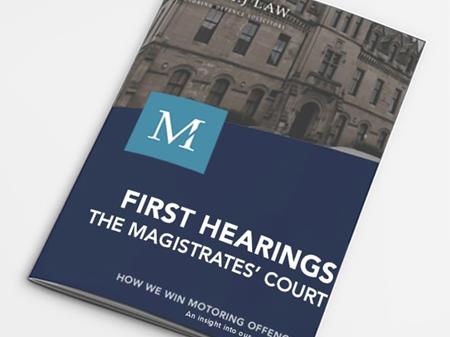
Your First Court Hearing - Do's and Don'ts
Worried about court? Don't be. Our team of specialist solicitors have over 20 years experience in defending drink & drug driving cases.
Your First Court Hearing
The UK's Leading Motoring Defence Firm
We are ranked in the top 10% according to ReviewSolicitors - an independent review platform. Click here if you want to read what other clients have to say.