

Drug driving prosecutions often depend heavily on one central piece of evidence: the result of a laboratory analysis of a blood sample. However, a blood result does not appear in isolation. Before a prosecution can rely on it, a detailed process takes place. This can involve the initial police stop, a roadside drug screening test, arrest, the evidential procedure at the police station, the taking of a blood sample and the subsequent handling, storage, transportation and laboratory analysis of that sample.
An important part of this process is recorded through the Manual of Guidance on Drink and Drug Driving, commonly referred to as the MGDD. The MGDD is a set of forms used by police forces in England and Wales when dealing with drink and drug driving investigations.
For many drug driving investigations conducted at a police station, the MGDD/B records and guides important parts of the evidential procedure. However, the booklet should not necessarily be viewed in isolation. Depending on the circumstances of the case, specialist solicitors may also need to consider custody records, police statements, body-worn video, custody CCTV, forensic documentation, laboratory evidence and other disclosure.
A mistake in an MGDD form does not automatically mean that a drug driving prosecution will be dismissed. Equally, procedural issues should not simply be ignored. The significance of an error will depend on exactly what happened, which legal requirement or procedure is in question and whether the prosecution can still establish its case with reliable and admissible evidence.
At MAJ Law, our specialist motoring solicitors regularly examine the evidential procedure in drug driving cases to determine whether the police and prosecution evidence withstands proper scrutiny.
What Is the MGDD/B?
The MGDD/B is part of the wider Manual of Guidance on Drink and Drug Driving framework.
The MGDD forms are designed to provide a structured framework for police officers dealing with suspected drink and drug driving offences. Different forms may be relevant depending on where and how the evidential procedure takes place. The Home Office publication includes forms for station procedures, general procedures, hospital procedures, laboratory submissions and impairment testing.
In a drug driving case involving an evidential blood sample, the documentation can provide an important record of what was said and done during the procedure. This matters because drug driving cases are often highly technical. A prosecution under section 5A of the Road Traffic Act 1988 is concerned with whether the concentration of a specified controlled drug in a person's blood or urine exceeded the prescribed limit. Current law requires evidential analysis of blood or urine for drug driving prosecutions, although the Government has considered the potential for alternative evidential testing methods in the future.
The procedure surrounding that evidence therefore deserves careful attention.
What Happens After a Roadside Drug Test?
Many drug driving investigations begin after a vehicle is stopped by the police.
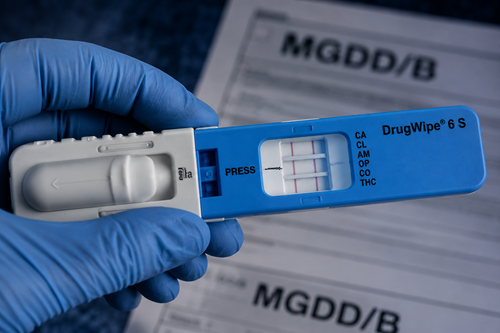
Depending on the circumstances, an officer may carry out a preliminary drug screening test, commonly known as a roadside drug swab or DrugWipe. These tests are screening devices rather than the final evidential laboratory test used to determine the precise concentration of a drug in a person's blood.
Current roadside oral-fluid screening commonly focuses on particular drugs, while evidential blood analysis can investigate a wider range of specified substances. Official government material confirms that current drug driving legislation relies on evidential analysis of blood or urine rather than roadside oral fluid alone.
If a driver is arrested and taken to a police station, the investigation may then progress to an evidential specimen procedure.
However, every case is fact-specific. It is dangerous to assume that the absence of one particular step automatically provides a defence without examining the statutory basis for the police action and the evidence as a whole.
Section 5A Drug Driving and Section 4 Driving While Unfit: What Is the Difference?
One of the first things a solicitor should establish is the precise offence being investigated or prosecuted. There is an important difference between driving with a specified controlled drug above the prescribed limit and driving while unfit through drugs.
A section 5A prosecution is concerned with the concentration of a specified controlled drug in the driver's blood or urine. The prosecution generally relies on forensic analysis to establish whether the relevant legal limit was exceeded.
A section 4 case is different. The issue is whether the person's ability to drive properly was impaired because of drugs. Evidence of the driver's condition, behaviour, manner of driving and performance in impairment testing may therefore become particularly important.
The distinction matters because the evidence required to prove each offence is different. A person can therefore be above a prescribed drug limit without the prosecution having to prove that they were visibly impaired in the same way required for an unfitness allegation. Understanding exactly which offence is being alleged is an essential starting point when reviewing the MGDD documentation and the wider prosecution evidence.
The Requirement to Provide an Evidential Specimen
The original version of this article described the provision of a blood sample as simply voluntary. That description requires more nuance.
A person cannot simply be physically forced to provide a blood specimen as part of an ordinary station procedure. However, where a lawful requirement to provide a specimen has been made, failing or refusing to provide the required specimen without reasonable excuse can itself amount to a criminal offence. The CPS confirms that a failure or refusal to provide a specimen without reasonable excuse can result in prosecution for failing to provide. This distinction is important.
A driver should not assume that saying “no” to a blood sample has no consequences. Equally, the circumstances in which a specimen was required, the warnings given, the reason for any failure and the procedure followed may all require careful legal consideration.
Some cases also involve genuine medical or other issues affecting a person's ability to provide a specimen. Whether those circumstances amount to a reasonable excuse is a fact-sensitive legal question and should be considered carefully.
Consent and the Taking of the Blood Sample
Where blood is being obtained as an evidential specimen, the process involves both the police officer conducting the procedure and an appropriate healthcare professional taking the blood.
The exact legal and procedural position can differ depending on the circumstances, particularly where the person is in hospital or is incapable of giving valid consent. The MGDD framework includes separate procedures for hospital cases.
In an ordinary drug driving investigation, a specialist solicitor may consider questions including:
- Was the correct evidential procedure followed?
- Was the requirement for the specimen lawfully made?
- Were the appropriate warnings given?
- Was consent properly addressed and recorded where required?
- Who took the sample?
- Were there any medical issues relevant to the procedure?
- Do the MGDD records agree with the custody record, CCTV and witness evidence?
These questions are important because a completed form is only one part of the evidential picture.
What Happens to the Blood Sample?
After an evidential blood sample is obtained, the procedure does not simply end. The specimen must move through a process before a forensic result can be produced. Depending on the case, this may involve division of the specimen, labelling, sealing, storage, transportation and receipt by the forensic laboratory.
The handling of toxicology samples matters because the prosecution must ultimately rely on the forensic result produced from the specimen. Current Forensic Science Regulator guidance, for example, addresses issues including appropriate storage of blood samples before analysis and the handling of sample-quality issues. The 2026 guidance states that blood samples should be refrigerated before analysis and discusses the potential effect of freezing and clotting on sample quality.
This is one reason why a specialist review of a drug driving case may extend beyond simply looking at the numerical laboratory result.
Is the Blood Sample Split Into Two Parts?
In relevant cases, a blood specimen may be divided so that part can be made available to the suspect for independent analysis. The precise wording here matters. It is misleading to suggest that one vial is simply handed to every person automatically in every case.
The CPS guidance addresses the division of specimens and the provision of part of the specimen to the suspect in accordance with the applicable procedure.
Independent analysis can be important in some cases. However, drivers should obtain legal advice before making assumptions about what a second analysis will achieve. The evidential issues may involve far more than simply whether another laboratory produces a slightly different number.
A specialist solicitor may need to consider the reported concentration, measurement uncertainty, the substance involved, sample integrity and the overall forensic evidence.

Why Is Continuity of Evidence Important?
Continuity, sometimes described as the chain of custody, concerns the ability to account for an evidential item as it passes through different stages of the investigation.
In a blood sample case, this can involve questions about:
- when the sample was obtained;
- who handled it;
- how it was labelled and sealed;
- where and how it was stored;
- how it was transported;
- when the laboratory received it; and
- whether the records are consistent.
A discrepancy does not automatically destroy a prosecution. The legal significance of any continuity issue depends on the nature of the discrepancy and the evidence available to explain or resolve it. However, where the prosecution relies heavily on a forensic blood result, unexplained problems concerning the identity, integrity or handling of the specimen can require detailed investigation.
This is why a proper defence review should not be limited to searching the MGDD/B for an empty box and declaring the case over. The real question is what the evidence shows happened.
Does an Error on the MGDD/B Automatically Mean the Case Is Dismissed?
No. This is probably the most important misconception to address. A spelling mistake, an incorrectly completed box or an administrative omission does not automatically make a blood result inadmissible or cause the prosecution to collapse. The significance of an error depends on its nature.
There is a major difference between a minor clerical mistake that can be explained by other reliable evidence and a substantive procedural problem affecting a legal requirement, the reliability of the specimen or the prosecution's ability to prove its case.
The CPS guidance itself recognises the evidential role of MGDD documentation and addresses how forms may be exhibited and used within the prosecution case. A specialist solicitor should therefore examine both the alleged error and the wider evidence before advising on its potential significance.
What Other Evidence Should Be Reviewed?
One of the weaknesses of viewing the MGDD/B as a standalone “loophole document” is that modern police investigations can generate a substantial amount of additional evidence. Depending on the case, a specialist drug driving solicitor may seek to examine:
Custody records. These can provide a timeline of arrest, detention and the evidential procedure.
Body-worn video. This may show conversations, warnings, the driver's condition and events before arrival at custody.
Custody CCTV. Where available and relevant, footage may assist in establishing what occurred during parts of the detention and evidential process.
Police statements. These should be considered against the contemporaneous documentation and any available footage.
Forensic documentation. Laboratory submissions, analytical evidence and continuity documentation may all be relevant to the reliability and interpretation of the blood result.
Medical evidence. In some cases, a medical condition or medication may be relevant to the events surrounding the procedure or to a statutory medical defence.
The purpose of a specialist defence review is to compare these sources of evidence and identify genuine inconsistencies or legal issues, rather than looking for errors in isolation.
What Types of MGDD/B Issues May Require Investigation?
Every case is different, but issues that may justify further investigation can include inconsistencies in the recorded timeline, questions about the requirement for a specimen, discrepancies concerning warnings or consent, problems identifying who carried out particular stages of the procedure, contradictions between the paperwork and video evidence, and unexplained issues surrounding the handling or continuity of the specimen. The key word is investigation.
The existence of a discrepancy does not determine the outcome of the case by itself. Its importance depends on the legal issue involved and what the rest of the evidence shows.
What Happens After the Blood Sample Is Taken?
After the sample is obtained and processed for submission, it is sent for forensic analysis. The laboratory will analyse the specimen for the relevant substances and report the findings. For a section 5A prosecution, the result is then considered against the prescribed limit for the particular specified controlled drug.
The legal limits vary significantly between substances. Government material lists separate concentration thresholds for drugs including THC, cocaine, benzoylecgonine, ketamine, amphetamine and a number of prescription medicines. If the result is above the relevant limit, the police may charge or prosecute the driver, subject to the circumstances and evidence in the case.
However, receiving an above-limit blood result does not mean that a driver should simply assume there is nothing for a solicitor to examine. The procedure, forensic evidence and any potential statutory defence should still be considered.
What About Prescription Medication?
The drug driving legislation applies to specified controlled drugs, including some medicines that can be lawfully prescribed. A person who is above the specified limit for a relevant medication may, depending on the circumstances, be able to rely on a statutory medical defence. The application of that defence depends on matters including whether the drug was prescribed or supplied for medical purposes and whether it was taken in accordance with the relevant directions. This is separate from the question of whether the MGDD/B procedure was followed correctly.
A proper defence strategy should consider all potentially relevant issues, rather than focusing exclusively on procedural errors.
Can You Defend a Drug Driving Charge After an Above-Limit Blood Result?
Potentially, yes. However, the availability of a defence depends entirely on the facts and evidence. An above-limit result is important prosecution evidence, but a specialist review may still consider:
- whether the prosecution can prove the identity of the driver;
- whether the alleged driving took place on a road or other public place where required by the offence;
- the evidential specimen procedure;
- forensic continuity and sample integrity;
- analytical and laboratory evidence;
- potential statutory defences;
- disclosure issues;
- inconsistencies between witnesses, documents and footage; and
- whether the prosecution can prove every element of the alleged offence.
No solicitor should promise that an administrative error will automatically result in acquittal. Equally, no driver should assume that an evidential blood result means that proper scrutiny of the prosecution case is pointless.
Why Specialist Legal Advice Matters in Drug Driving Cases
Drug driving law combines criminal procedure, road traffic legislation and forensic evidence. This can make apparently straightforward cases much more technical than they first appear.
The MGDD/B may be an important part of the investigation, but identifying an error is only the beginning of the legal analysis. The real questions are whether the correct legal procedure was followed, whether the prosecution evidence is reliable and admissible, whether every element of the offence can be proved and whether any defence applies.
At MAJ Law, our specialist motoring solicitors examine the evidence behind the blood result, not simply the result itself.
If you have been accused of drug driving, early specialist advice can help you understand the evidence, the procedure that was followed and the options available to you.
Free Initial Advice From MAJ Law
MAJ Law is a specialist motoring defence firm representing motorists facing allegations including drug driving, drink driving, failure to provide a specimen and other serious motoring offences.
If you are under investigation or have been charged with drug driving, contact our specialist team for free initial advice on 0151 422 8020, or leave your details and a solicitor will call you back.