

When M.A.J Law first reported on the growing use of so-called “ghost” number plates earlier this year, one of the biggest unanswered questions was simple: just how widespread is the problem? We may now be starting to get an answer.
A new BBC Panorama investigation has revealed that thousands of illegal registration plates are being detected by specialist camera technology currently being tested on roads in south-east England.
At one test site near the Dartford Crossing, the system has recorded an average of more than 1,000 suspected ghost plates every day for several months. At another site near the M25, detections have reportedly increased from around 1,000 a day to almost 2,000, while another system near the Eurotunnel at Folkestone is flagging more than 400 every day. BBC Isle of Man
For an issue that has historically been extremely difficult to measure, largely because these plates are specifically designed to avoid detection, the figures provide a striking indication of the potential scale of the problem. And the investigation has uncovered something else: just how easy illegal number plates can apparently be to obtain.
What Has Changed Since We Last Reported on Ghost Plates?
Ghost plates themselves are not new. They are registration plates that have been modified or manufactured so that all or part of the registration becomes difficult for conventional Automatic Number Plate Recognition (ANPR) cameras to read.
Our previous investigation into the issue explained how reflective coatings, films, altered lettering and specialist materials can interfere with camera systems. The significant development now is the technology being used to fight back. MAV Systems, one of the UK's major ANPR technology providers, has been testing a new camera capable of detecting and reading ghost plates that conventional systems may fail to identify. The early results suggest the problem is far from isolated (BBC Isle of Man)
The UK's ANPR network is enormous. According to the BBC investigation, approximately 14,000 ANPR sites capture around 100 million number plates every day. These cameras are not simply used to issue speeding fines. Police rely on ANPR to identify and track vehicles connected with uninsured driving, stolen vehicles and serious criminal investigations, while camera systems are also used for road charging and low-emission zones. BBC Isle of Man
If a vehicle can effectively disappear from that network, the implications go considerably further than avoiding a fine.
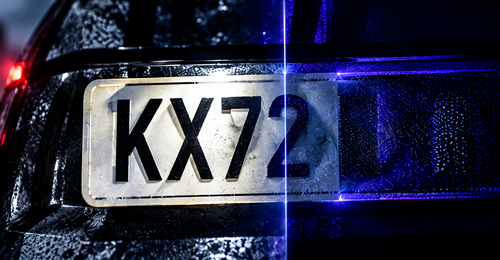
More Than 1,000 Detections a Day at Just One Location
Perhaps the most significant finding from Panorama is the data emerging from the new cameras.
Near the Dartford Crossing, the technology has recorded an average of more than 1,000 ghost-plate detections every day over several months. Two other test sites have reportedly been operating for almost two years.
Near the M25, detections have increased from around 1,000 per day to nearly 2,000. Near the Eurotunnel at Folkestone, more than 400 are being flagged each day (BBC Isle of Man)
There is an important distinction here. These figures represent detections rather than necessarily individual vehicles. A vehicle passing the same camera repeatedly could potentially be detected more than once. Even with that qualification, however, the figures demonstrate why illegal registration plates have become a significant focus for police and the Government.
Undercover Investigation Exposes the Supply Problem
The technology is only one part of the story. Panorama also investigated how easily illegal registration plates can be obtained.
There are more than 34,000 businesses registered with the DVLA to supply number plates in the UK. Yet a Freedom of Information request obtained by Panorama found that only two suppliers have been prosecuted and forcibly removed from the DVLA register since 2020. Perhaps most strikingly, the BBC reports that just six DVLA officers are responsible for inspecting and auditing the thousands of registered suppliers across the UK. (Yahoo News)
Undercover reporters also approached number plate businesses and found examples of ghost plates apparently being offered for sale without the checks motorists might expect. That creates a problem at both ends of the system.
Enforcement is not simply about catching motorists using illegal plates; authorities also have to consider how those plates are entering circulation in the first place.
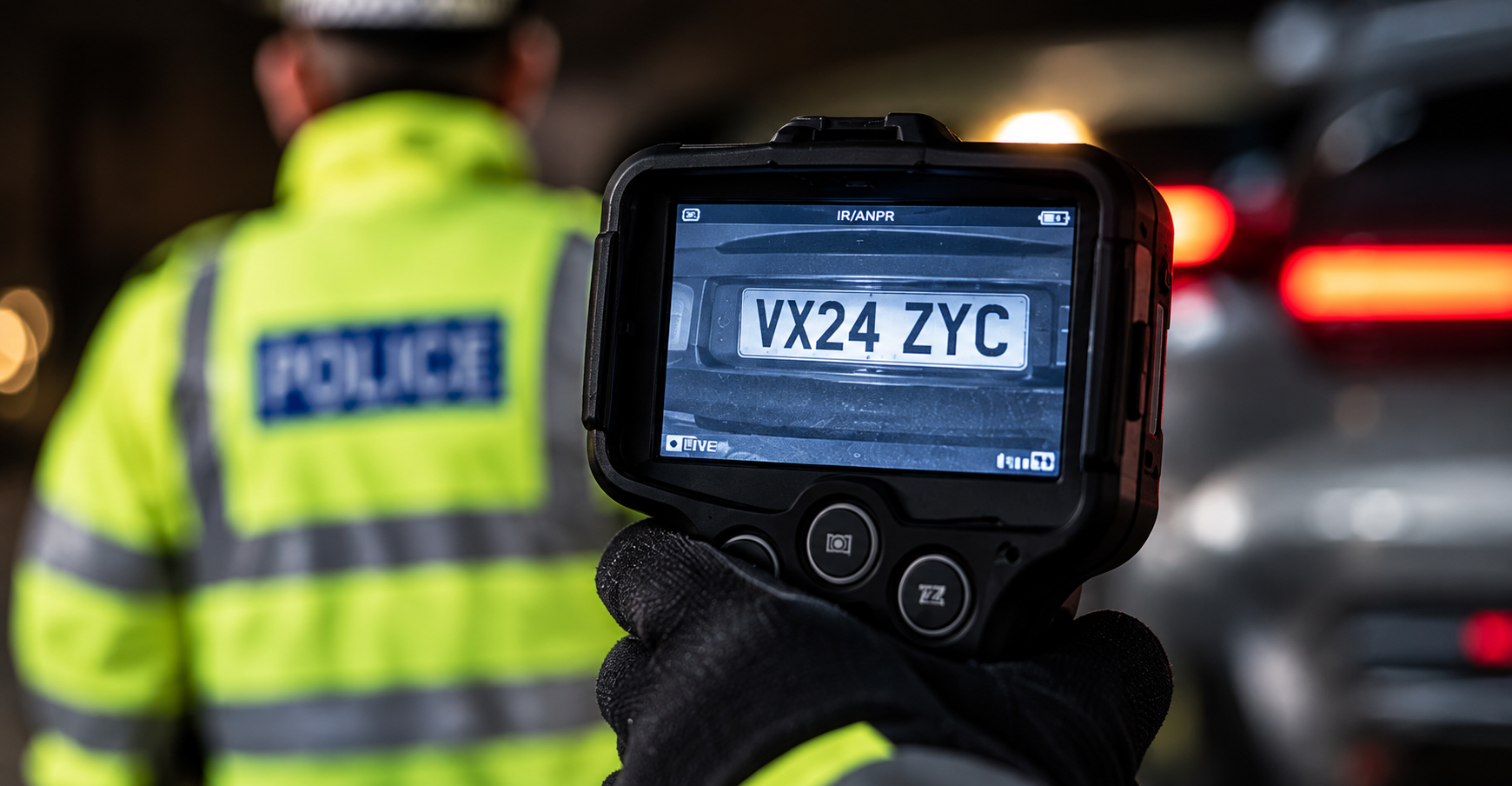
Police Are Now Using Infrared Goggles
One of the more unusual developments involves technology that looks like something from a science-fiction film. Panorama joined police and DVLA officers during an operation on the border of Birmingham and West Bromwich, where officers were using specialist infrared goggles.
The goggles effectively allow officers to examine registration plates in a similar way to an ANPR camera. During the operation, a van was stopped and the goggles revealed that it was displaying a ghost plate. The driver was issued with a £100 fine, although he told officers that he had been unaware the plate was illegal. (Yahoo News)
Police and DVLA officers subsequently visited the plate supplier. According to the BBC, staff denied selling ghost plates, but the specialist equipment identified two ghost plates among those displayed on the premises, while police also found separate ghost letters and numbers. The supplier received a warning letter and prosecution was still being considered when Panorama reported the story. (Yahoo News)
This technology is already part of a wider national operation. The National Roads Policing Coordination Centre confirmed earlier this month that forces are trialling specialist goggles capable of detecting plates designed to be unreadable by cameras. (National Police Chiefs' Council (NPCC))
This Is About More Than Avoiding Speed Cameras
One of the misconceptions surrounding ghost plates is that they are primarily used by motorists attempting to avoid speeding tickets, parking charges or clean-air-zone penalties. The BBC investigation highlights why police view the issue much more seriously.
Chief Constable Tim Forber, the UK's policing lead for ANPR, told Panorama that not a week goes by without police seeing an example of cloned plates being connected to serious and organised crime. (Yahoo News)
A recent West Yorkshire Police operation provides some context. During a week-long operation targeting ghost, cloned and untraceable number plates, officers stopped 183 vehicles. Arrests were made for offences including dangerous driving, theft and breach of bail, while 14 vehicles were seized for matters including disqualified driving, no insurance or driving without a licence. Six cloned vehicles were also seized. (National Police Chiefs' Council (NPCC))
In other words, hiding a vehicle's identity can provide a means of avoiding detection for offences considerably more serious than a missed toll or speeding ticket.
Families Have Already Experienced the Consequences
Panorama also spoke to families affected by fatal collisions in which illegal or concealed registration plates were involved.
In 2023, motorcyclist Jason Wallis died following a collision in Buckinghamshire. His brother-in-law, Lewis Baker, survived and was later jailed for dangerous driving. Baker admitted using a device to hide his registration plate from public view and told the court that the pair had previously ridden at high speed on more than 100 occasions. BBC Isle of Man
Another case involved 81-year-old Graham Slinn, who was killed on a pedestrian crossing in 2025 by a vehicle displaying cloned plates. The driver, Cain Byrne, was unlicensed and uninsured and had inhaled nitrous oxide shortly before the collision. Police eventually identified him after examining hours of CCTV footage, including footage showing him fitting the illegal plates to the vehicle. He was subsequently jailed for 11 years and six months for causing death by dangerous driving, driving while disqualified and driving without insurance. (BBC Isle of Man)
These cases demonstrate why the debate surrounding ghost and cloned plates has moved well beyond number-plate technicalities.
Could Ghost Plates Soon Mean Penalty Points - or Vehicle Seizure?
This is where the position becomes particularly relevant from a motoring-law perspective. Currently, an illegal registration plate can result in a financial penalty, but the Government has already consulted on substantially tougher sanctions.
Its 2026 consultation specifically asked whether motorists found in charge of vehicles displaying incorrect, altered or false number plates should receive penalty points. It also asked whether police should be given powers to seize those vehicles, similar to existing powers available in certain insurance and driving-licence cases. (GOV.UK)
Importantly, these remain proposals rather than the current law. The consultation closed on 11 May 2026, and the Government confirmed this month that responses are still being considered. (UK Parliament)
That distinction matters because headlines surrounding the crackdown can give motorists the impression that penalty points and seizure have already been introduced specifically for ghost-plate offences. They have not. However, the direction of travel is clear: authorities are examining whether the current sanctions are sufficient when an illegal plate has deliberately been used to prevent a vehicle from being identified.
A National Crackdown Is Already Underway
There has also been an important development since our previous article. A new National Roads Policing Coordination Centre is now coordinating work between police forces across England to tackle illegal registration plates.
Funded by the Department for Transport, its work includes intelligence sharing, improving collaboration between forces and trialling technology capable of identifying plates designed to evade cameras. The DVLA is separately considering changes intended to create a more robust and auditable Register of Number Plate Suppliers, including potential changes to the structure, resources and funding of the scheme.
That is significant because enforcement against motorists addresses only half of the issue. If ghost plates remain inexpensive and straightforward to obtain, authorities also need to address the businesses supplying them.
So, Where Does This Leave Drivers?
For most motorists, nothing has changed overnight. It remains important to distinguish between what the law currently says and what the Government is considering introducing.
Drivers can already face enforcement action for displaying registration plates that fail to comply with legal requirements. But the proposed introduction of penalty points and new vehicle-seizure powers has not yet become law. (GOV.UK)
What has changed is our understanding of the scale of the problem. When we first examined ghost plates in June, reliable data was extremely difficult to obtain precisely because the plates were designed to evade the cameras used to identify them. Now, specialist technology is beginning to expose what ordinary ANPR systems may have been missing.
More than 1,000 detections a day near Dartford. Nearly 2,000 a day at another site near the M25. More than 400 a day near Folkestone. (BBC Isle of Man)
Those figures do not tell us exactly how many individual vehicles are using ghost plates nationally. But they do explain why police, the DVLA and the Government are investing increasing resources into tackling them. The interesting question now is no longer simply whether ghost plates are a problem. It is what the Government decides to do about them.
Need Advice About an Illegal Number Plate or Motoring Offence?
If you have received a penalty or are being investigated in connection with an illegal registration plate or another motoring offence, the legal position will depend on the individual circumstances.
M.A.J Law specialises exclusively in motoring law and represents drivers throughout England and Wales. Contact our team for specialist advice about your case.