

New Ministry of Justice figures reveal that motoring prosecutions in England and Wales have reached their highest level in a decade, with 812,000 prosecutions recorded in 2025. Driving bans have also risen sharply, while hundreds of thousands of motorists received penalty points.
Motoring prosecutions across England and Wales have reached their highest level in ten years, according to the latest figures from the Ministry of Justice. Approximately 812,000 motoring prosecutions were recorded in 2025, representing a 5% increase compared with 2024. But the figures reveal more than simply an increase in the number of motorists being taken to court.
Direct driving disqualifications increased by 29%, dangerous driving prosecutions rose by 34%, and more than 100,000 prosecutions were brought for failing to provide information about the identity of a driver. Meanwhile, around 395,000 motorists received penalty points without being disqualified.
For drivers, the latest figures demonstrate how quickly a motoring allegation can progress from a letter through the door or roadside stop to penalty points, prosecution or even the loss of a driving licence.
812,000 Motoring Prosecutions in England and Wales
According to the Ministry of Justice's latest Criminal Justice Statistics, there were approximately 812,000 prosecutions for motoring offences in England and Wales during 2025.
This represents a 5% increase compared with the previous year and the highest annual figure recorded during the last decade. Three categories alone accounted for approximately 65% of all motoring prosecutions:
- Vehicle insurance offences
- Vehicle registration and excise licence offences
- Speed limit offences
However, motorists can face prosecution for a much wider range of road traffic offences, including:
- Drink driving
- Drug driving
- Dangerous driving
- Careless driving
- Speeding
- Driving without insurance
- Using a mobile phone while driving
- Failing to provide a specimen
- Failing to identify the driver
- Driving whilst disqualified
- Vehicle registration and licensing offences
The potential consequences vary enormously depending upon the allegation. While some offences may initially be dealt with through a fixed penalty, others can result in mandatory disqualification, substantial fines or, in the most serious circumstances, imprisonment.
Failure to Identify the Driver Prosecutions Rise 19%
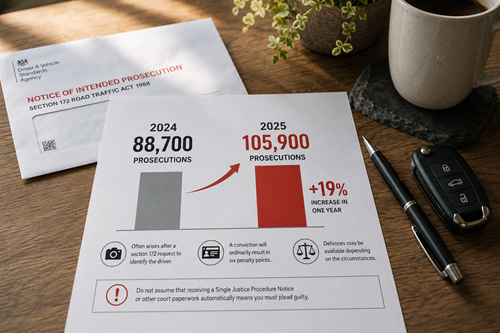
One of the most significant increases recorded by the Ministry of Justice involved motorists accused of failing to provide information about the identity of a driver. Prosecutions increased from approximately 88,700 in 2024 to 105,900 in 2025. That represents an increase of around 19% in just one year. These cases commonly arise following a request made under section 172 of the Road Traffic Act 1988.
For example, when a vehicle is detected speeding by a camera, the registered keeper may receive a Notice of Intended Prosecution together with a requirement to identify who was driving the vehicle at the relevant time. Ignoring the request or failing to provide the required information can potentially result in a separate criminal offence. A conviction for failing to provide driver information will ordinarily result in six penalty points.
For motorists who already have points on their licence, those additional six points can potentially result in a totting-up disqualification. However, defences may be available depending upon the circumstances.
A driver should therefore avoid assuming that receiving a Single Justice Procedure Notice or other court paperwork automatically means they must plead guilty.
Vehicle Registration and Excise Offences Reach Record Levels
The Ministry of Justice also recorded a significant increase in vehicle registration and excise licence offences. Approximately 161,700 prosecutions were recorded during 2025, compared with around 147,200 in 2024. That represents an increase of approximately 10% in a single year. Compared with 2015, the number of prosecutions in this category has increased by approximately 98,000 cases.
The figures are particularly significant because they demonstrate that motoring enforcement is not limited to offences involving the way somebody physically drives a vehicle.Vehicle registration, licensing, insurance and driver information can all potentially result in enforcement action and prosecution.
Drivers should therefore ensure that their vehicle and licence information remains accurate and up to date.
Dangerous Driving Prosecutions Increase by 34%
The latest figures also reveal a sharp increase in prosecutions for one of the more serious road traffic offences. Approximately 4,700 dangerous driving prosecutions were recorded during 2025. That represents a 34% increase compared with the previous year and the highest figure recorded in the Ministry of Justice series.
Dangerous driving is a serious criminal offence. Under the Road Traffic Act 1988, driving may be considered dangerous where the standard of driving falls far below what would be expected of a competent and careful driver and it would be obvious to a competent and careful driver that driving in that way would be dangerous.
Dangerous driving allegations can arise from many different circumstances, potentially including excessive speed, aggressive driving, prolonged distraction, racing or other particularly serious standards of driving. The consequences of conviction can be severe.
Depending upon the circumstances and the offence charged, motorists can face:
- A substantial driving disqualification
- An extended driving test before regaining a full licence
- A fine
- Community penalties
- Imprisonment in serious cases
Where dangerous driving results in death or serious injury, the sentencing powers available to the court become significantly greater. Anyone accused of dangerous driving should therefore seek specialist legal advice as early as possible.

More Than 100,000 Drivers Directly Disqualified
The rise in prosecutions has also been accompanied by a major increase in motorists losing their driving licences. Ministry of Justice statistics show that approximately 104,000 offenders were directly disqualified from driving in 2025. That compares with around 81,000 during 2024. This represents an increase of approximately 29% in just one year.
A further 23,800 motorists were disqualified through the penalty points system, while approximately 395,000 offenders received penalty points without being disqualified. For many motorists, losing a driving licence can have consequences far beyond simply being unable to drive.
A disqualification can potentially affect:
- Employment
- Businesses
- Family responsibilities
- Childcare
- Caring responsibilities
- Financial commitments
- Independence
This makes obtaining specialist advice particularly important where a driver is facing an offence carrying penalty points or mandatory disqualification.
When Do Penalty Points Result in a Driving Ban?
For most motorists, accumulating 12 or more penalty points within a three-year period can result in a minimum six-month driving disqualification under the "totting up" provisions. However, reaching 12 points does not necessarily mean that a driving ban is inevitable.In certain circumstances, a driver can ask the court to consider whether a disqualification would cause exceptional hardship.
Exceptional hardship is a specific legal test. Simply showing that losing a licence would be inconvenient is unlikely to be enough. The court will consider the individual circumstances and, importantly, the impact a driving ban could have upon other people. Specialist preparation can therefore be crucial when advancing an exceptional hardship argument.
New Drivers Can Lose Their Licence With Six Points
Drivers who passed their first driving test within the previous two years face a different risk. Under the Road Traffic (New Drivers) Act 1995, accumulating six or more penalty points within two years of passing a first driving test can result in the DVLA revoking the driver's licence. This is different from a court-imposed driving disqualification.
Once the licence is revoked, the motorist will generally need to apply for a new provisional licence and pass both the theory and practical driving tests again before obtaining a full licence. A single offence carrying six penalty points can therefore have major consequences for a newly qualified driver.
95% of Motoring Sentences Result in a Fine
Financial penalties remain by far the most common sentence imposed for motoring offences. According to the Ministry of Justice, approximately 95% of sentences for motoring offences during 2025 resulted in a fine.
The average fine imposed on individuals also increased. In 2024, the average fine was approximately £310. By 2025, this had increased to approximately £327. However, motorists should not assume that £327 represents the maximum financial penalty they could face. The amount of any fine depends upon several factors, including the offence, seriousness of the circumstances and the defendant's financial position.
Drivers convicted at court may also be ordered to pay:
- Prosecution costs
- A victim surcharge
- Other associated financial penalties
Certain motoring offences can also carry an unlimited fine.
Can You Go to Prison for a Motoring Offence?
Although the majority of motoring convictions do not result in imprisonment, custody remains a possibility for more serious road traffic offences. The Ministry of Justice recorded an overall 1% custody rate for motoring offences during 2025. The average custodial sentence imposed on those receiving immediate custody was approximately 10.8 months. That compares with an average of approximately 7.5 months in 2015.
The likelihood of imprisonment depends heavily upon the offence and circumstances. Serious cases involving dangerous driving, causing death or serious injury by driving and certain repeat offences can expose motorists to substantial custodial sentences.
Drink Driving: Why a Conviction Can Mean an Automatic Ban
Drink driving remains one of the most serious common motoring offences because a conviction for driving or attempting to drive while over the prescribed alcohol limit carries a mandatory driving disqualification.
For a first offence, the minimum disqualification is generally 12 months. The actual length of the ban will depend upon factors including the alcohol reading, the circumstances of the offence and any previous relevant convictions. The court can also impose an unlimited fine and, in more serious cases, imprisonment.
However, a positive evidential reading does not mean the prosecution's case should simply be accepted without scrutiny. Depending upon the circumstances, a specialist drink driving solicitor may examine issues including:
- The circumstances of the initial police stop
- The roadside breath test
- The evidential breath procedure
- Whether blood or urine was obtained
- The operation of evidential equipment
- Medical issues affecting the procedure
- Continuity and handling of specimens
- Laboratory analysis
- Police documentation
- Forensic evidence
- Whether the prosecution can prove every element of the alleged offence
The correct defence strategy will always depend upon the individual circumstances of the case.
Drug Driving: You Do Not Have to Appear Impaired
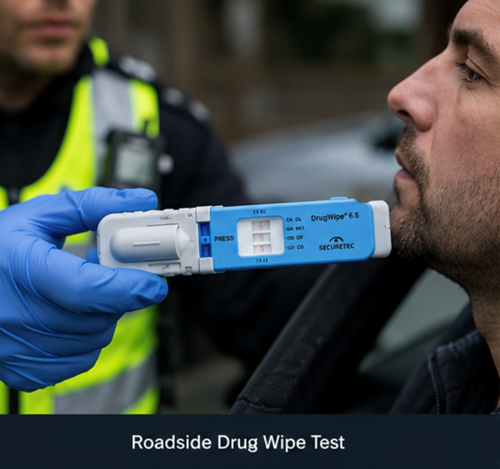
Drug driving prosecutions can also result in a mandatory driving disqualification. Under section 5A of the Road Traffic Act 1988, it is an offence to drive, attempt to drive or be in charge of a motor vehicle with a specified controlled drug above the prescribed limit. The legislation covers illegal substances as well as certain prescription medications.
One important distinction is that a prosecution under section 5A does not necessarily require the prosecution to prove that the driver appeared visibly impaired. Instead, the case may centre upon whether the concentration of a specified drug in the driver's blood exceeded the prescribed legal limit.
A drug driving conviction can result in a minimum 12-month driving disqualification when the person was driving or attempting to drive, alongside a fine and potentially other penalties.
Drug driving cases can involve complex scientific and procedural evidence. Depending upon the circumstances, this may include:
- Roadside drug testing
- Police observations
- Blood sampling procedures
- Medical evidence
- Continuity of samples
- Storage and transportation
- Laboratory analysis
- Forensic reports
- Prescription medication
- Statutory medical defence arguments
- Police procedural documentation
These issues can require detailed examination by specialist motoring solicitors.
Driving Without Insurance: Six Points Can Have Serious Consequences
Driving without valid insurance is another offence capable of producing significant consequences. Police can issue a fixed penalty of £300 and six penalty points for driving without insurance. If the case proceeds to court, a driver can potentially receive an unlimited fine and may be disqualified from driving.
Police also have powers to seize vehicles being driven without valid insurance. Insurance cases are not always as straightforward as they initially appear. Disputes can arise over matters such as:
- Whether a policy was valid
- Whether the driver was covered to drive the particular vehicle
- Whether a policy had been cancelled
- Whether the motorist had been informed about cancellation
- Whether an employer or vehicle owner had provided incorrect information
In certain circumstances, a motorist may also be able to advance a special reasons argument relating to the circumstances in which the offence occurred.
Speeding Remains a Major Source of Motoring Prosecutions
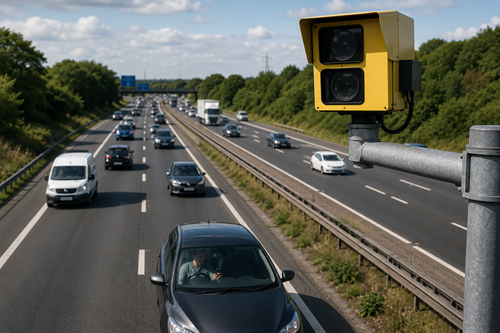
Speed limit offences remain one of the largest categories of motoring prosecutions in England and Wales. Speeding offences can be detected through a variety of enforcement methods, including:
- Fixed speed cameras
- Mobile camera vans
- Average speed cameras
- Police speed detection equipment
- Smart motorway enforcement cameras
Depending upon the speed alleged and circumstances, a motorist may be offered a speed awareness course or fixed penalty rather than being prosecuted at court. However, higher speeds, repeat offending and cases where a driver already has a significant number of penalty points can result in court proceedings.
The potential penalty will depend upon the alleged speed, applicable limit and driver's existing record.
Received a Notice of Intended Prosecution?
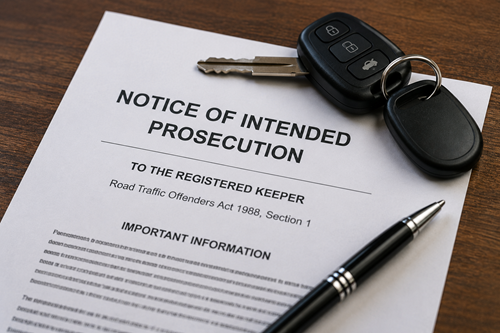
A Notice of Intended Prosecution (NIP) is commonly associated with offences such as speeding. Receiving a NIP does not mean that a driver has already been convicted. However, it is important not to simply ignore the notice. The correspondence may also contain a requirement under section 172 of the Road Traffic Act 1988 requiring the registered keeper or another person to identify the driver. Failure to respond correctly can potentially result in a separate prosecution carrying six penalty points.
The latest Ministry of Justice figures show just how significant this has become, with more than 105,000 prosecutions for failing to provide driver information during 2025 alone.
If you believe a NIP contains incorrect information, did not receive the original correspondence or genuinely cannot identify the driver, specialist legal advice may be required.
Why Are Motoring Prosecutions Increasing?
The Ministry of Justice statistics demonstrate that motoring prosecutions are increasing, but the figures do not necessarily mean that drivers are suddenly behaving significantly worse. Modern road traffic enforcement increasingly relies upon technology and national databases.
Police and other authorities now have access to tools including:
- Automatic Number Plate Recognition (ANPR)
- Fixed and mobile speed cameras
- Average speed enforcement
- Roadside drug testing
- Digital insurance databases
- DVLA vehicle information
- Automated enforcement systems
These systems can make offences easier to detect and investigate. At the same time, some of the largest increases recorded in the latest statistics involve administrative and regulatory offences, rather than allegations involving dangerous behaviour behind the wheel.
The Ministry of Justice specifically highlighted increases in vehicle registration and excise licence offences and failing to identify a driver as factors contributing to the overall rise. That distinction is important. The headline figure of 812,000 prosecutions does not represent 812,000 cases of dangerous driving. Instead, it covers an enormous range of alleged offences, from vehicle documentation and speeding through to drink driving, drug driving and serious dangerous driving cases.
What Should You Do If You Are Accused of a Motoring Offence?
If you receive correspondence from the police, DVLA or court relating to a motoring offence, it is important not to ignore it. Depending upon the allegation, you may receive:
- A Notice of Intended Prosecution
- A section 172 driver information request
- A Single Justice Procedure Notice
- A postal requisition
- A court summons
- A charge following a police investigation
Before entering a guilty plea, motorists should understand exactly what offence is alleged, what evidence exists and what consequences a conviction could have. There may be legal, evidential or procedural issues that require investigation.
Obtaining advice early can also be particularly important where a driver already has penalty points or relies heavily upon their licence for work or family responsibilities.
Specialist Motoring Solicitors
The latest Ministry of Justice figures provide a clear picture of the scale of motoring enforcement across England and Wales. With 812,000 prosecutions in a single year, 104,000 direct driving disqualifications and hundreds of thousands of motorists receiving penalty points, a road traffic allegation should not automatically be dismissed as "just a fine". For many people, their driving licence is essential to their employment, business and family life.
At MAJ Law, we specialise exclusively in defending motorists. Our specialist motoring solicitors represent drivers facing allegations including:
- Drink driving
- Drug driving
- Dangerous driving
- Careless driving
- Speeding
- Failing to provide a specimen
- Failing to identify the driver
- Driving without insurance
- Mobile phone offences
- Totting-up disqualifications
If you have been charged with a motoring offence or have received a Notice of Intended Prosecution, Single Justice Procedure Notice, postal requisition or court summons, obtaining specialist advice at an early stage can make a significant difference.
Our solicitors can examine the evidence, explain the potential consequences and identify whether there are any legal, evidential or procedural issues that could affect your case.
Contact MAJ Law today to speak to a specialist motoring solicitor about your case.
Source: Ministry of Justice, Criminal Justice Statistics Quarterly: December 2025, published 2026.