

Former England footballer Raheem Sterling is due to appear in court after being charged with dangerous driving, failing to provide a specimen and possession of nitrous oxide for wrongful inhalation following a crash on the M3.
The 31-year-old former Manchester City, Chelsea and Liverpool winger was arrested after his Lamborghini collided with motorway barriers in Hampshire earlier this year. No other vehicles were involved in the collision and no injuries were reported.
However, the incident has subsequently resulted in Sterling facing three separate criminal charges, including two motoring offences which can carry significant consequences for a driver if convicted.
So, what exactly is Sterling accused of, and what could happen next?
What Happened on the M3?
According to Hampshire & Isle of Wight Constabulary, the incident happened on the M3 southbound close to the Minley Interchange in Hampshire on 28 May 2026. Sterling's Lamborghini was involved in a single-vehicle collision with motorway barriers. He was arrested following the incident and later released on bail while police enquiries continued.
Sterling has now been charged with:
- Dangerous driving
- Failing to provide a specimen
- Possession of nitrous oxide for wrongful inhalation
He is due to appear at Basingstoke Magistrates' Court on 15 September 2026. It is important to emphasise that these are allegations at this stage. Sterling has not been convicted of the offences and the case remains subject to court proceedings.
Dashcam Footage Emerges Following M3 Collision
Footage shared online appears to show Sterling’s Lamborghini travelling along the M3 prior to the collision. The video, shared by Stardriven.tv, shows the vehicle travelling on the motorway before the incident which subsequently led to Sterling’s arrest.
Watch the footage below:
Video courtesy of Stardriven.tv – used with permission.
Why Was Sterling Not Charged With Drug Driving?
One particularly interesting aspect of the case is the difference between the offence initially being investigated and the charges Sterling now faces. Police reportedly suspected Sterling of driving whilst unfit through drugs following the collision. However, no drug-driving charge appears among the offences subsequently brought against him.
A source close to Sterling previously told BBC Sport that there was "no proof" of drugs in his system. That distinction is important. An arrest on suspicion of an offence does not automatically result in somebody being charged with that offence.
Following an arrest, investigators must consider the evidence available and prosecutors must determine whether the appropriate legal test for bringing a charge has been met. In Sterling's case, the court proceedings will instead concern dangerous driving, failing to provide a specimen and possession of nitrous oxide for wrongful inhalation.
What Is Dangerous Driving?
Dangerous driving is a serious criminal motoring offence. The legal test does not simply ask whether somebody made a mistake behind the wheel.
Broadly, driving can be considered dangerous where the standard of driving falls far below what would be expected of a competent and careful driver, and it would be obvious to a competent and careful driver that driving in that way would be dangerous.
Cases can involve allegations such as:
- excessive or inappropriate speed;
- aggressive driving;
- dangerous overtaking;
- ignoring road conditions;
- racing;
- serious distraction;
- driving a vehicle in a dangerous condition; or
- other prolonged or particularly serious examples of poor driving.
The precise allegation against Sterling will ultimately depend upon the prosecution evidence presented to the court. A collision itself does not automatically prove dangerous driving. The prosecution must establish the elements of the offence beyond reasonable doubt.
What Happens if Someone Is Convicted of Dangerous Driving?
A conviction for dangerous driving can have extremely serious consequences. Unlike a relatively minor road traffic offence, dangerous driving can result in imprisonment. A person convicted will also face an obligatory driving disqualification and will normally be required to pass an extended driving test before being permitted to drive again.
The eventual sentence will depend upon the circumstances of the offence, including the nature of the driving, the level of danger created and any aggravating or mitigating factors.
For somebody who depends heavily upon their driving licence for their career or personal circumstances, the consequences can therefore extend considerably beyond the courtroom.
What Does 'Failing to Provide a Specimen' Mean?
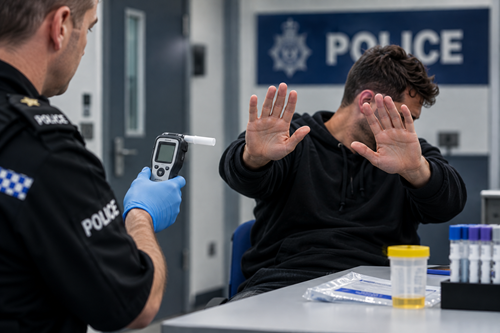
Sterling has also been charged with failing to provide a specimen. This is an offence MAJ Law deals with regularly. Where police are investigating suspected drink or drug driving, a motorist may be required to provide an evidential specimen.
Depending upon the circumstances, this could involve breath, blood or urine. Failing, without reasonable excuse, to provide a specimen when lawfully required can itself amount to a criminal offence.
Crucially, a person does not necessarily need to be convicted of drink or drug driving to be prosecuted for failing to provide. The alleged failure itself can form the basis of a separate prosecution.
Can You Have a Reasonable Excuse for Failing to Provide?
Yes.
Not every failure to provide an evidential specimen automatically results in a conviction. The legislation provides a defence where a person can establish that they had a reasonable excuse for failing to provide. Whether an excuse is legally sufficient will depend heavily upon the individual circumstances.
Medical conditions can sometimes become particularly important in these cases, although simply telling the police that providing a specimen is difficult will not necessarily amount to a defence. The procedure followed by police can also require careful examination.
At MAJ Law, when defending failing-to-provide allegations, we examine the evidence surrounding the requirement itself, what happened at the police station or hospital, what explanations were given and whether the correct procedure was followed.
The Nitrous Oxide Charge
The third charge makes this case particularly unusual. Sterling has been charged with possession of nitrous oxide for wrongful inhalation.
Nitrous oxide - commonly known as laughing gas, NOS or balloons, became a Class C controlled drug in the UK in 2023 where it is possessed with the intention of wrongfully inhaling it for a psychoactive effect. The presence of nitrous oxide in a motoring case is especially topical.
Earlier this year, Hampshire & Isle of Wight Constabulary and Thames Valley Police began testing what police described as the world's first nitrous oxide breathalyser. The technology is designed to detect whether somebody has recently inhaled nitrous oxide, with police describing nitrous oxide use by motorists as an emerging road-safety concern.
The trial is significant because proving recent nitrous oxide consumption has historically presented difficulties for investigators.
Nitrous Oxide and Driving: An Emerging Area of Motoring Law
Unlike substances such as cocaine and cannabis, which have specified statutory limits for drug-driving offences, nitrous oxide presents different evidential challenges. Its effects can nevertheless be extremely dangerous behind the wheel.
Police have warned that inhalation can cause effects including loss of consciousness, while the rapid disappearance of nitrous oxide from the body has historically made roadside detection particularly difficult. This is precisely why new detection technology is now being explored.
Interestingly, despite Sterling facing a charge concerning possession of nitrous oxide, he has not been charged with drug driving or driving whilst unfit through drugs. The possession allegation and the allegation concerning his standard of driving therefore remain legally distinct matters which the prosecution will have to prove.
Read our full blog on nitrous oxide offences here.
One Incident - Three Very Different Allegations
Sterling's case is a useful example of how a single road traffic incident can result in several completely different areas of criminal and motoring law coming together. A motorway collision may begin a police investigation. That investigation may lead to questions surrounding drink or drugs.A requirement for an evidential specimen may then be made.
Separately, police may investigate the standard of driving itself. Each resulting allegation has its own legal test and evidential requirements.
Being involved in a collision does not automatically establish dangerous driving. Being suspected of drug driving does not automatically establish that drugs were present above a legal limit or that somebody was unfit to drive. And failing to provide a specimen is itself a separate offence for which particular procedures and potential defences apply. That is why the evidence surrounding the entire incident, rather than simply the headline allegation, can become crucial.
What Happens Next for Raheem Sterling?
Sterling is currently due to appear before Basingstoke Magistrates' Court on 15 September. The proceedings are at an early stage and no findings of guilt have been made. Given the seriousness of a dangerous-driving allegation, the case may subsequently progress beyond the Magistrates' Court depending upon how proceedings develop.
For now, Sterling faces three charges arising from the May motorway collision. The case will undoubtedly attract considerable attention because of his profile as a former England international. But away from the celebrity name, the allegations highlight an important point relevant to any motorist facing prosecution: serious motoring cases are rarely as simple as the headline makes them appear.
Facing a Dangerous Driving or Failing to Provide Charge?
MAJ Law specialises exclusively in motoring and driving offences. Our solicitors represent motorists across England and Wales facing allegations including dangerous driving, drink driving, drug driving and failing to provide a specimen.
Early specialist advice can be particularly important where a case involves forensic evidence, police procedure or the potential loss of a driving licence. If you have been charged with a motoring offence and want to understand your options, contact MAJ Law for specialist advice.